BURIED TOGETHER
Partner Laura Johnson Wylie
Queer Places:
University of Michigan, 1230 Murfin Ave, Ann Arbor, MI 48109
Vassar College (Seven Sisters), 124 Raymond Ave, Poughkeepsie, NY 12604
112 Market St, Poughkeepsie, NY 12601, USA
Vassar Brothers Institute, 12 Vassar Street, Poughkeepsie, NY 12601
Woodlands Cemetery, 4000 Woodland Ave, Philadelphia, PA 19104, United States
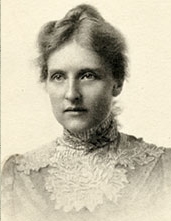 Gertrude Buck (July 14, 1871 – January 8, 1922) was a pioneering American educator, a visionary pioneer in composition-rhetoric, and a transformative professor at Vassar
College. Alongside her life and professional partner, Department Chair Laura Johnson Wylie, Buck helped reshape modern
pedagogy, championing the view that writing and literature are fundamentally social instruments intimately connected to human experience, democratic community life, and
social action.
Gertrude Buck (July 14, 1871 – January 8, 1922) was a pioneering American educator, a visionary pioneer in composition-rhetoric, and a transformative professor at Vassar
College. Alongside her life and professional partner, Department Chair Laura Johnson Wylie, Buck helped reshape modern
pedagogy, championing the view that writing and literature are fundamentally social instruments intimately connected to human experience, democratic community life, and
social action.
Gertrude Buck was born on July 14, 1871, in Kalamazoo, Michigan, to Judge George M. Buck and his wife, Annie. Possessing a brilliant intellect from a young age, she
pursued her higher education entirely at the University of Michigan, earning a Bachelor of Science in 1894, a Master of Science in 1895, and ultimately her Ph.D. in Rhetoric
and Composition in 1898—making her the first American woman to receive a doctorate in that specific field.
In 1897, Buck joined the Vassar College faculty as an English instructor, rising quickly within the department to become an Associate Professor in 1901 and a full
Professor in 1907. She taught at Vassar continuously until her death in 1922.
At Vassar, she worked closely with Laura Wylie to radically change the methods and courses of the department, forwarding the progressive educational philosophies of John
Dewey. Together, they drastically reduced class sizes, petitioned year after year for faculty expansion, and swelled the variety of writing courses. Buck's pedagogical
strategy was remarkably systematic: she would teach a new course until she determined the most efficient way to convey the material, write a definitive textbook on it, and
then guide a new teacher into her place, ensuring her innovative methods outlived her direct instruction.
Modern rhetoricians and feminist scholars recognize Buck's writings as laying the vital foundations for feminine rhetoric and the rise of New Rhetoricians—scholars who
understand writing as a social action and communication as a community experience. Rather than building up a massive personal portfolio of creative works, the naturally
frail Buck chose to focus her limited energies on reinventing the Vassar curriculum and authoring five vital composition textbooks, alongside works reflecting her interests
in psychology, literary criticism, poetry, and plays. Her textbooks and articles continued to illustrate fundamentals of writing and teaching for decades, earning her
entries in the 1914 Woman's Who's Who of America, the 1921 Who's Who Among North American Authors, and posthumously in the 1943 Who Was Who in America.
Refusing the conventional choice between career and marriage, Buck lived in downtown Poughkeepsie at 112 Market Street with her closest friend and partner, Laura Wylie.
Their home allowed both women active participation in local civic issues, far removed from standard campus insularity.
President Henry Noble MacCracken famously described the vibrant intellectual circle that included Buck and Wylie as a "creative group," noting, "Dangerous women all of
them. They rejoiced in every conflict of ideas. The times were ripe for change."
Deeply civic-minded, Buck and Wylie worked together as members of the Equal Suffrage League of Poughkeepsie, served on the board of directors of the Women's City and
County Club, and aligned with progressive political movements, with Buck joining the Socialist Party of the State of New York.
Buck's impact on Vassar extended far beyond the English department. In 1915, she participated in George Pierce Baker's legendary 47 Workshop at Radcliffe College. Upon
her return, she introduced Vassar's first playwriting course and guided the Vassar Dramatic Workshop into existence in 1916. The Workshop allowed students to write, produce,
and act in entirely original productions—notably featuring future Pulitzer Prize-winning poet Edna St. Vincent Millay as
a senior writer and star actress.
Inspired by the success of the campus workshop, Buck sought to fuse her campus efforts with her community activism by founding the Poughkeepsie Community Theatre in 1919.
True to her democratic ideals, she hoped to create an environment where all social classes could work together to find artistic self-expression. President MacCracken
observed that "Miss Buck's method was always stimulation of the inner motives... The result of her efforts was the development in Poughkeepsie of a group genuinely devoted
to the art of the theatre."
The success of the student theater movement led President MacCracken to establish a $1,000 drama fund in 1918. Following her passing, it was renamed the Gertrude Buck
Drama Fund to support books on drama. Though a formal Drama Department did not exist during her tenure, this fund and her workshops laid the direct foundation for Vassar's
Division of Drama established in 1934.
The intense physical and emotional labor of founding the Poughkeepsie Community Theatre took a severe toll on Buck's fragile health. In August 1921, a sudden paralytic
stroke cut her work short. True to her beliefs as a Christian Scientist, she refused conventional medical treatment, suffering through months of partial recovery before
passing away from a second stroke on January 8, 1922, at the age of 50.
Buck's legacy reverberated deeply across generations:
In November 1933, the home she had shared with Laura Wylie became the official headquarters of the Women's City and County Club in honor of their civic dedication.
On August 29, 1976, representatives from Vassar's Drama, English, Development, and Secretary offices dedicated a memorial plaque to Professor Gertrude Buck in the lobby
of Avery Hall.
In 1984, the Rhetoric Society Quarterly officially recognized Buck as a master rhetorician whose framework anticipated modern rhetoric studies.
Following Laura Wylie's death in 1932, the two women were laid to rest together, forever united by an epitaph that encapsulated their life's work, love, and partnership:
“We Two One Another’s Best”
References:
Other references:
- Vassar Encyclopedia (Biographical profile hosted by the Vassar College Historian)
- Woman's Who's Who of America (1914 Edition)
- Who's Who Among North American Authors (1921 Edition)
- Who Was Who in America (1943 Edition)
- Rhetoric Society Quarterly (1984 Scholarly Recognition and Retrospective)
- Writings and Memoirs of President Henry Noble MacCracken (President of Vassar College, 1915–1946)
Support this project
This website is a passion project researched, developed, and funded entirely by me. If you find the content valuable and would like to help support the ongoing research and hosting costs, any contribution is deeply appreciated.
Thank you for keeping this independent resource alive!
My books on Amazon: Elisa Rolle's books
BACK TO HOME PAGE
